Sunday, February 20, 2022

What Foreign Companies should know about Xiamen’s Economy

 With three and a half million citizens in the city proper and roughly four million in the built-up area of the city, Xiamen is only the thirtieth most populated city in China. However, the city had a GDP of 600 billion yuan and a GDP per capita of 142,000 yuan in 2019. This makes Xiamen one of the most prosperous and wealthy cities within China. What’s more, with a GDP growth rate of 7.9% in 2019, the city is outperforming most other Chinese cities. Let’s find out why Xiamen’s economy is outpacing the growth of other prosperous Chinese cities.


Located in southeast China across the strait from Taiwan, Xiamen is about halfway between Hong Kong and Hangzhou. Even though it is not the capital nor most populous city in Fujian province, it is arguably one of the most important. With a reputation for doing business, Fujian has been one of the best performers economically in China’s history. With an economy the size of Sweden or Thailand and a population comparable to the US state of California, or the entire nation of Canada, the province of Fujian is an important asset to China. Furthermore, Fujian’s economy is one of the fastest growing in China, overtaking that of Taiwan in size this year, a meaningful milestone in Cross Straits affairs.

Xiamen's location

The location of Xiamen in the southeast of Fujian Province between Quanzhou and Zhangzhou, two other economically successful coastal Chinese cities. Fujian’s desirable location along the coast and across the strait from Taiwan have helped Xiamen’s economy and that of the province as a whole. Source – China Highlights.

The Legacy of Xiamen’s SEZ Status continues to benefit the city

Setup as a Special Economic Zone in 1980, Xiamen enjoyed early access to international markets and as such has built up a strong business standing among other Chinese cities. In recent years, Xiamen has emerged as one of the most competitive markets in China, ranked eight nationally in terms of intellectual capital and innovation in 2018 by the China Development Research Foundation. In 2019, the city was ranked as one of the top ten best performing cities in China by Milken Institute. The city’s history of being a city of business has no doubt contributed to it being the birthplace of national champions such as Luckin Coffee and Meitu, a photo beautification app.

To best understand the economy of Xiamen, foreign companies will need to be aware of Xiamen’s special role in Fujian’s economy and how the economics of urbanization have helped the city achieve such rapid economic success. In addition, companies will need to be aware of how Xiamen’s aviation industry and tourism in Xiamen have played a role in the city’s economic growth. Finally, foreign companies will need to look to Xiamen’s Cross Straits Business to understand what is driving outside funding to the city.

Animation of urbanization of Xiamen Island

Animation of urbanization of Xiamen Island and surrounding regions between 1984 and 2012. Not only is the rapid construction of infrastructure and urban amenities during this period visible, but it is also clear how much Xiamen’s economy was transformed by land-reclamation projects. Source – Business Insider

How the Economics of Urbanization are positively affecting Xiamen’s Economy

In the last 40 years, Xiamen’s economy has exploded in growth as the city enjoyed the effects of urbanization. China’s opening up reforms and the city’s designation at a special economic zone. However, some of the city’s most rapid economic growth has occurred within the last fifteen years, with the city’s urban development spreading from Xiamen Island across to the mainland coastal area.

With the construction of numerous expressways and high-speed rail lines crisscrossing Fujian in recent years, Xiamen has become increasingly connected to nearby cities in recent years. Zhangzhou, a city of nearly 5 million people is located merely 40 kilometers from Xiamen Island. A high-speed rail now connects the two cities in 20 minutes. Quanzhou, which has more than 8 million citizens, is located 55 kilometers from Xiamen Island. A thirty minute high-speed rail trip connects the two cities. These three cities make up a metropolitan area of more than 10 million people.

A glittery night skyline reflects the prosperity of Xiamen’s economy

A glittery night skyline reflects the prosperity of Xiamen’s economy, which has become one of the most competitive and innovative cities in China in recent years. Source – China Daily

Specialization has significantly increased as Xiamen grows outward

The urbanization in Xiamen have not only contributed to a larger population and higher economic growth, but it has also helped the city further specialize its markets. The development of numerous industrial zones across the Greater Xiamen area has given the city a leading edge over others in terms of competition. This leading edge has given the city another economic boost.

xiamen's metro

Map of Xiamen Metro, with completed and under construction lines. The rapid expansion of metro construction has added not only to the effects of urbanization in Xiamen, but also to the growth of the economy of Xiamen. Source – Wikipedia.

The city’s internal transport connections have also developed quickly as the city expands outwards. The Xiamen Metro opened in 2017 with one line that connected communities on the island to the city’s northern train station. In 2019, a cross-island metro line opened, connecting business districts on the island. In the coming years however, multiple lines will open that will connect the island with businesses and industries on the mainland coastal area. Two of these new lines will connect the network to Xiamen’s new airport, which will open in late 2020. These connections will provide quicker transport around the city and will also increase land values near metro corridors. These benefits will further benefit Xiamen’s economy.

Companies examining Xiamen would do well to keep in mind how the economics of urbanization are creating a healthy business environment in the city. This is happening as urbanization creates a large metropolitan market, increases specialization and improves transport around the city.

XiamenAir has become one of the largest airlines in China

Founded in 1984, XiamenAir has become one of the largest airlines in China, with over 70 domestic and international destinations. With Xiamen’s Gaoqi Airport serving as the airline’s hub, XiamenAir has greatly contributed to Xiamen’s economy over the years.  Source – China Daily

How Xiamen’s Aviation Industry and Role as Logistics Hub propel its economy

With more than thirty years in service, XiamenAir has put Xiamen on the map. With more than twenty international destinations, the airline has connected Xiamen to multiple foreign markets. This has in turn led to a decrease in the amount of time it takes to travel to Xiamen, which increases the economy’s competitiveness. In addition, the growth of passenger throughput at the city’s airport has led officials to call for the construction of a new airport. The new airport is expected to cost more than 7 billion yuan and provide double the flight capacity of the current airport. In addition, it will undoubtedly give a growth boost to the economy of Xiamen.

Xiamen’s Aviation Industry coupled with the city’s booming logistics industry are fueling each other’s growth. Promoted by the central government in Beijing, Xiamen’s logistics industry is one of nine important logistics hubs in China. As such, the city enjoys increased support for the development in this sector. In recent years, the city has opened new logistics parks across the city, such as Haicang Logistics Park and Xinlin Logistics Park.

A historical connection with foreign merchants

Called Amoy by European merchants for hundreds of years, Xiamen has a long history as an entrepot with foreign merchants. With a long history as a major seaport, it is no surprise that shipping still takes up a large portion of the city’s economy. Xiamen’s seaport is the 8th largest container port in China and the 17th largest in the world. The port of Xiamen handled 217 million tons of cargo in 2018, which was a 3% increase on 2017.

Foreign companies would do well to realize that Xiamen punches way above its weight when it comes to aviation, logistics and shipping. Due to historical and geographic reasons, the city will likely continue to attract a large amount of cargo and passenger throughput.

manufacturing hub that opened in 2018 in Xiamen

An advanced innovation and manufacturing hub that opened in 2018. Complexes like these in and around the city are propelling Xiamen’s economy as one of the most advanced manufacturing markets in China. Source – ABB

How high-tech manufacturing in Xiamen has boosted the city’s economic standing  

Xiamen’s high-tech manufacturing industry has High-tech components: LCD displays, communications equipment and semiconductors. In addition, the city government has established multiple high-tech industrial zones across the city. These include the Xiamen Torch Hi-Tech Industrial Zone and

High-tech manufacturing in Fujian’s economy has had a huge impact on the economy of Xiamen, adding a reported $61 billion to the city’s economy in 2018. The graphene and tungsten metals industries have shown strong potential in recent. What makes high-tech manufacturing in Xiamen so successful however is the city’s treatment towards the industry. With countless incentives and subsidies, it is no wonder many high-tech manufacturers are flocking to the city.

Foreign companies can benefit from Xiamen and Fujian’s high-tech manufacturing industry by observing how state policies are favoring certain productions in Xiamen. It is worth noting how the development of high-tech manufacturing has had such a huge impact on the city’s economic growth over the past few decades.

Tourists flock to the tropical beaches of Gulangyu, Xiamen

Tourists flock to the tropical beaches of Gulangyu, a historic island destination adjacent to Xiamen Island. Tourism is one of the main pillars of the economy of Xiamen. Source – CFP

How Tourism in Xiamen is helping boost the economy

Gulangyu Island is one of the most popular domestic tourist attractions in Mainland China. Once a colonial entrepôt off the coast of Amoy, the island developed a strong heritage of global refinement during the heyday of Xiamen’s maritime boom. Nowadays, the island is still full of colonial architecture, trendy shops and sweeping vistas of the city across the bay. In recent years, Gulangyu has become a couples destination, especially among younger Chinese tourists. All in all, the island attracts more than 10 million tourists each year, bringing a boost to Xiamen’s tourism industry.

Besides Gulangyu and other attractions within the urban area, Xiamen is also a base for tourists going to other nearby destinations. Tourists flock to Xiamen as a starting point when visiting the Tulou circular houses in rural Fujian province. In addition, many tourists visiting nearby Kinmen Island transit via Xiamen. The city welcomed 96 cruise ships in 2018, with many ships bringing international tourists. It is estimated that tourists visiting the city add nearly $20.6 billion to Xiamen’s Tourism Industry every year.


Photo of tourist replicating internet celebrity poses in Xiamen. Photos like these are appearing all over social media and tourism websites. Source: Douguo Meishi

Xiamen is filled with photo-opportunities for tourists

In addition to the obvious attractions, Xiamen attracts a large amount of tourists looking to replicate photos taken by internet celebrities. Tourists and millennials alike flock to cafés and boutiques in the city, especially those where a Chinese celebrity once appeared on social media. These otherwise un-noteworthy locales have are appearing all over the city, from Xiamen University to Gulangyu to the city center. These wanghongdian, as they are called by trendy Chinese youth, are a boon to Xiamen’s economy. 

89 million number of tourists visit Xiamen each year, with most of those tourists coming from other parts of China. This number has increased by more than 13% from the previous year, as Xiamen becomes an increasingly popular destination. Foreign companies looking to benefit from tourism in Xiamen would do well to keep in mind that tourists go not only to Gulangyu Island, but also to other places in the city and greater Fujian. Foreign companies would do well to note that young tourists are also visiting quaint corners of the city popularized by internet celebrities.

A view of Taiwan’s Shi Islet with the skyline of Xiamen’s skyline in the background, a bustling economy

A view of Taiwan’s Shi Islet with the skyline of Xiamen’s skyline in the background. Due to the geographical and cultural proximity of Xiamen to Taiwan, Cross Straits business has been a boon to Xiamen’s economy. Source – Reuters

How Xiamen’s Cross-Straits Business drives economic growth

Visible from Taiwan, Xiamen has long had strong ties with the island of Taiwan. Xiamen has had continuous maritime trade with Taiwan and also witnessed a diaspora of Fujianese to the territory. In addition, Xiamen’s proximity with Kinmen and Lieyu Islands, which are a part of Taiwan, adds to Xiamen’s Cross-Straits Business. The strong connection between the city and Taiwan have had a lasting impact on the economy of Xiamen.

Established in 2015, the China-Taiwan IC Free Trade Zone became a new free-trade business zone with the goal of increasing business between Xiamen and Taiwan. The zone. Companies that set up in the zone have access to a wide range of incentives. A year before in 2014, there were a reported 4,300 companies started by Taiwanese entrepreneurs in Xiamen. Besides the free-trade zone, Xiamen also holds a yearly business conference that specifically targets Taiwanese entrepreneurs. In 2018, the Straits Forum attracted more than 10,000 people, the largest number in many years.

A connection to Taiwan

In addition, the city of Xiamen as well as the province of Fujian offer special incentives to Taiwanese entrepreneurs looking to set up shop in the city. These range from recognition of vocational certificates to living stipends. In addition, subsidies have been offered to Taiwanese entrepreneurs with higher education. These range from subsidies for those with masters degrees to subsidies for on-site job training.

Foreign companies can get a slice of the pie by paying attention to what kinds of Taiwanese businesses are lured in by Xiamen’s generous policies. In addition, foreign companies would do well to watch trends in the movement of Xiamen’s diaspora in Taiwan, some of whom have returned to the island.

Container ships being unloaded in the port of Xiamen. Xiamen's Economy

Container ships being unloaded in the port of Xiamen, which has grown significantly in recent years to become one of the busiest in the world. The economy of Xiamen has benefitted from the city’s role as an international shipping port throughout the city’s history. Source – China Daily

Takeaways for Foreign Companies watching Xiamen’s Economy

Cities along China’s southeast seaboard provide many opportunities for foreign companies, but few offer as many advantages as Xiamen. From its long history as an international seaport to its strategic location on the southeast coast of China, Xiamen’s economy has a lot to offer foreign companies.

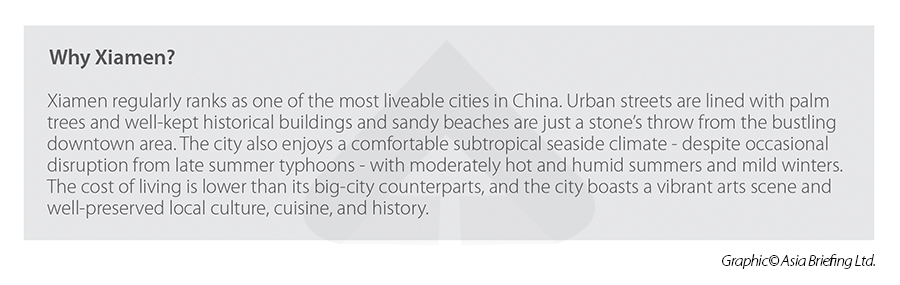
When considering Xiamen as a possible city of business, foreign companies should keep in mind Xiamen’s pivotal place within Fujian’s Economy as well as how the economics of urbanization have created a large metropolitan region surrounding Xiamen. In addition, companies should remember how Xiamen’s Aviation Industry, Xiamen’s Logistics Industry and Xiamen’s High-tech Manufacturing Industry are regional leaders in their respective fields. Companies also must not underestimate the domestic power of tourism in Xiamen and how it is boosting profits across the city and region. Finally, foreign companies must understand how cross-straits business ties and the Fujian Diaspora in Taiwan continue to benefit the economy of Xiamen.

Xiamen Investment Opportunities

 Xiamen is among China’s fastest-growing cities by GDP growth. Its economy is diversifying and modernizing, building upon its mainstay shipping and manufacturing industries and developing high-tech and modern service capabilities. With a dynamic industrial and business landscape in place as well local preferential policies for incoming companies, this seaside city offers a wide range of growth prospects for foreign investors. Xiamen is a sub-provincial city located in the south-eastern province of Fujian. Perched on the western shoreline of the Taiwan Strait, the city has historically enjoyed a position as an important seaport, in particular for the export of tea, porcelain, and paper.  In modern times, the city’s trade has shifted to the import and export of commodities such as foodstuffs and crude oil, as well as cross-border e-commerce, in particular electronics.  Xiamen was one of the first cities to reopen to foreign trade and investment during China’s reform and opening-up period. In 1981, it was designated as one of just four ‘special economic zones’ (SEZ), areas that are granted looser restrictions on international trade and investment, as well as preferential policies aimed at accelerating development. 

Today, the city’s economy is diversifying and modernizing fast. Powered in large part by booming international trade and a thriving shipping and logistics industry, the city has successfully protected itself from the worst of the pandemic. At the same time, emerging industries, such as fintech, high-end manufacturing, and high-end technology are finding fertile ground in which to grow, cultivated by beneficial government policies.

Did you know? Xiamen was historically known to outsiders as ‘Amoy’. The name comes from the Hokkien dialect that is still widely spoken in Fujian province.

With its growth-friendly environment and strategic position on China’s southeast coast, the city offers exciting prospects for foreign investors in a wide range of industries.

Xiamen’s economic profile 

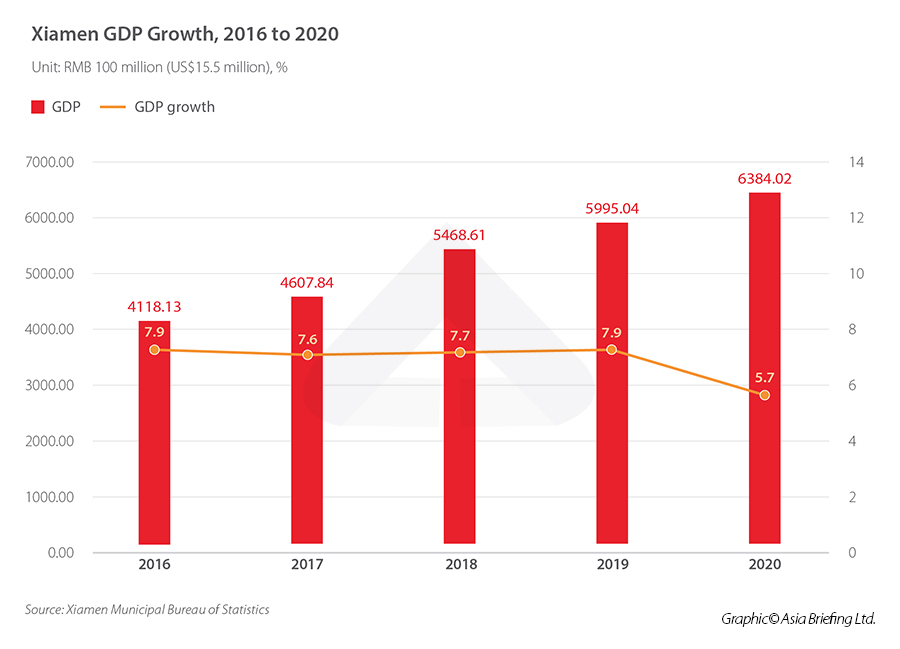
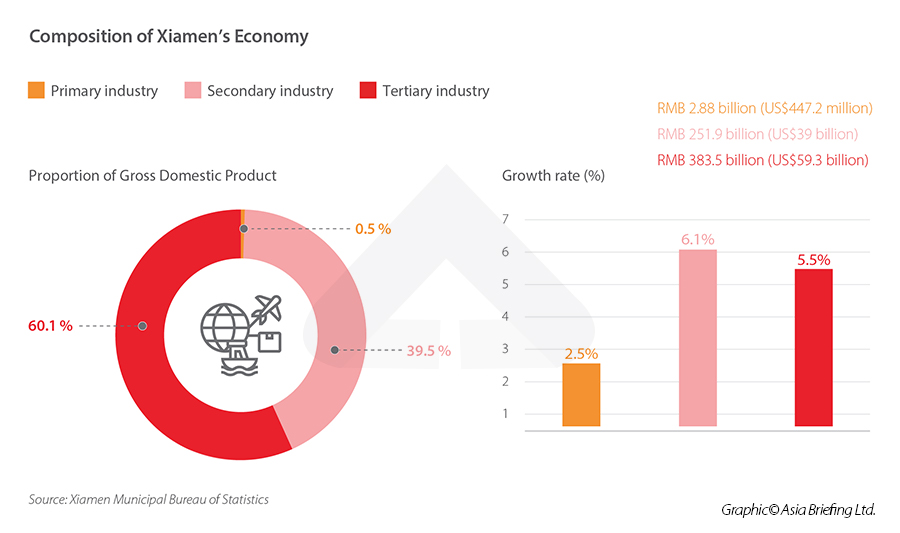
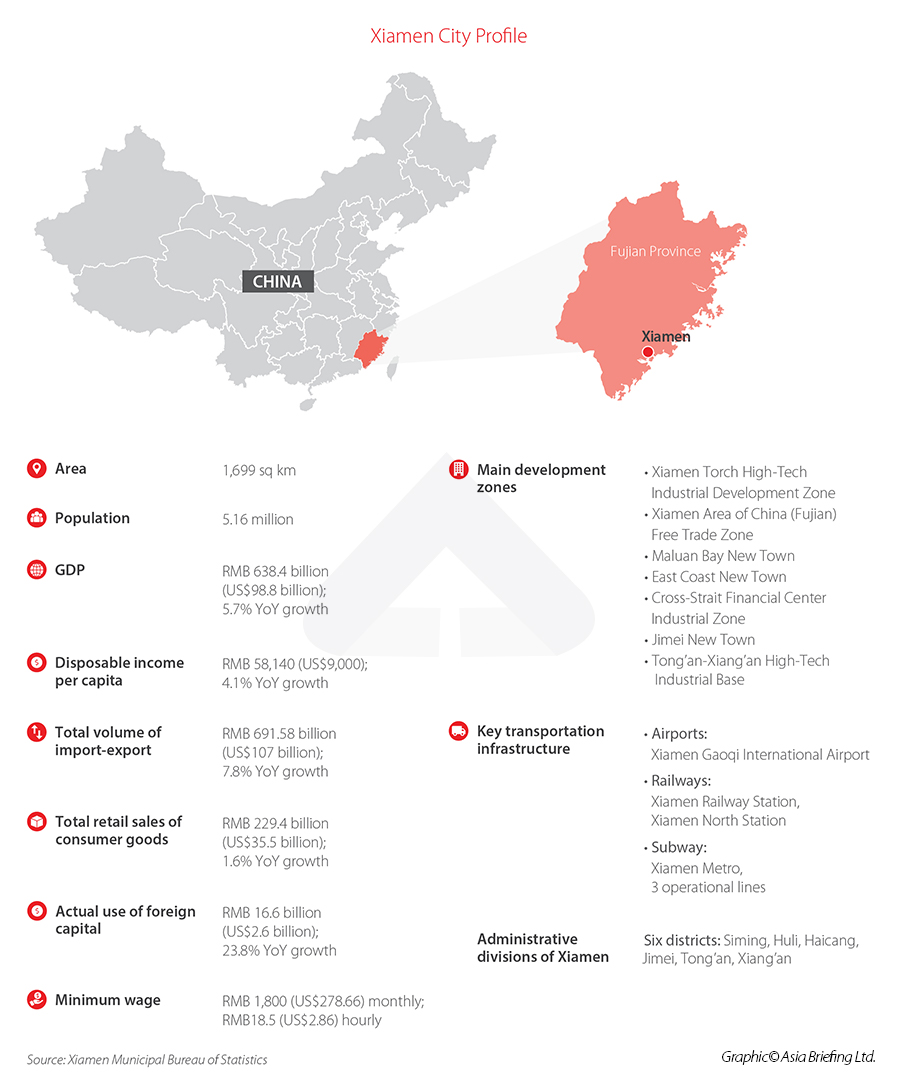
Over the past five years, Xiamen has maintained a higher level of economic growth compared to both the provincial and national averages, with an average annual growth rate of 7.4 percent from 2016 to 2020. Even as the COVID-19 pandemic took its toll, Xiamen’s 2020 GDP growth rate beat national averages, increasing 5.7 percent to RMB 638.4 billion (US$98.5 billion). That is 3.4 percentage points above the national average and 2.4 percentage points above the provincial average.Xiamen GDPMeanwhile, Xiamen’s economic composition has also undergone a significant shift over the past decade. Tertiary sectors surpassed 60 percent of the local GDP for the first time in 2020, marking an inexorable turn toward reliance on the services for economic growth, a trend seen in many cities across the country.Xiamen Industry CompositionXiamen was able to absorb the worst of the impact of the pandemic thanks in large part to strong trade and investment numbers in 2020, both of which saw positive growth from the previous year.  The total volume of import-export reached RMB 691.58 billion (US$107 billion), an all-time high.  Xiamen’s biggest foreign trade partners in 2020 were ASEAN, the U.S., and the European Union, which made up 43 percent of overall trade. Trade with countries that form part of China’s Belt and Road Initiative (BRI) also grew 13.2 percent year-over-year to reach RMB 229 billion (US$35.5 billion). Actual use of foreign capital in 2020 was similarly positive, seeing a 23.8 percent year-over-year growth to reach RMB 16.6 billion (US$2.6 billion). This accounts for almost half of the total foreign direct investment (FDI) in the entire province. The majority (65.2 percent) of foreign capital went to the services sector, in particular industries like leasing and business services, accommodation and catering, and wholesale and retail. Foreign capital use in high-tech service industry R&D and design services increased 1.3-fold year-over-year.Xiamen Economic Figures

Labor market

Xiamen has a relatively young and well-educated workforce when compared to other cities in the region. According to the 2020 population census, the average age of the city’s population is 36.8 years, six months younger than the provincial average and two years younger than the national average.

However, the city is currently on the brink of becoming an ‘ageing society’, with the proportion of over-60s at 9.56 percent, just shy of the 10 percent threshold for official designation. The population is also increasingly well-educated and Xiamen is home to some of China’s most renowned universities, most notably Xiamen University. Among the over-15 population, the average number of years of education has risen from 10.29 in 2010 to 11.17 in 2020. In the meantime, the number of people with a university education per 100,000 grew from 17,799 to 26,940. 

Xiamen’s mainstay industries 

Electronics and machinery manufacturing 

Xiamen’s economy still heavily relies on its two largest mainstay industries: electronics and manufacturing. In 2020, the total output value of these two industries reached RMB 496.7 billion (US$76.9 billion), accounting for almost 70 percent of the city’s total industrial output value of enterprises above a designated scale. (Note that “enterprises above a designated scale” is a technical designation used by Chinese statisticians to denote industrial companies with an annual income of RMB 20 million or more deriving from its main business (US$3.1 million).) Some of the most significant sub-fields within the electronics industry are flat panel displays, computers and communication equipment, liquid crystal display (LCD) components, and integrated circuits (ICs). In 2020, the total industrial output value for the flat panel displays and communication equipment industry broke RMB 100 billion (US$15.5 billion).  The industrial output value of machinery and equipment manufacturing enterprises above a designated size reached RMB 225.2 billion (US$34.8 billion), an average annual growth rate of 9.9 percent. Among major sub-fields within this industry are automotive, electrical appliances, aircraft maintenance, general equipment manufacturing, and special equipment manufacturing.  Major companies operating in this space in Xiamen include Toshiba, Fujitsu, Boeing, LG, and Japan Airlines, to name a few. 

Hi-tech and advanced manufacturing industries 

As with many cities across China, Xiamen is seeking to future-proof its economy by increasing focus and investment on high-tech and ‘strategic emerging industries’. These are industries that are considered key to China’s overall technological development, such as high-end equipment manufacturing, biopharmaceuticals, new energy, and new energy vehicles.  Much of the high-tech industry is concentrated in the Xiamen Torch High-Tech Industrial Development Zone, which seeks to cultivate emerging industries, including ICs, microelectronics, high-end equipment manufacturing, and biopharmaceuticals, and has attracted multinationals such as Panasonic, AU Optronics, and Nippon Electric Glass. The industrial output value of high-tech companies above a designated size reached RMB 76.6 billion (US$11.8 billion) in 2020, accounting for 39.8 percent of the city’s overall industrial output value. 

Modern services 

Having surpassed the 60 percent of overall GDP mark, Xiamen’s service industry is accumulating many of the trappings of a maturing economy. ‘Traditional services’, such as postal and courier services, retail and wholesale, remain an important section of the economy, while new modern services, such as software and information services, modern logistics, and fintech, are gaining significant ground. 

Xiamen has a well-developed financial industry, which realized RMB 78.4 billion (US$12.1 billion) in added value in 2020, a year-over-year increase of 5.3 percent. The city is striving to become an influential financial hub and develop innovative financial sectors, in particular fintech. To encourage development in this area, a Financial Technology Industrial Park is currently being built in Siming District. Companies that set up within the park will be eligible for a variety of monetary rewards and support, including rent subsidies, rewards for economic contribution, and tax benefits for high-level talent.  Due in part to its pleasant weather and environment, Xiamen has hosted many high-profile conferences and forums and has a thriving conference and exhibition industry and ample infrastructure to host large corporate and political events. 

Maritime industries 

Xiamen’s economy is still relatively dependent on maritime industries: in 2020, gross ocean product (GOP) reached RMB 140.529 billion (US$21.7 billion), accounting for 22 percent of the local GDP.  Much of this economic activity is conducted through the Port of Xiamen, an important deep-water port and a key shipping and logistics hub for the wider region. Located in the northwest of Xiamen Island, the port is the eighth largest in China and consists of nine container terminals.   Industries that support the trade and shipping sector are therefore many in number and have been an important driver of the city’s post-pandemic recovery. Transportation, warehousing, and postal industries accumulated a total operating income of RMB 34.2 billion (US$5.3 billion) in the first half of 2021, a year-over-year increase of 29.7 percent.  The municipal government is also seeking to promote recreational maritime sectors, such as recreational fishing, cruises, yachting, and sailing, and other ocean-related leisure industries. 

City-wide incentive policies 

The main city-wide policies on foreign investment currently in place in Xiamen were laid out in a document released in 2018, titled Several Measures for Promoting Foreign Investment in Xiamen.  The measures seek to encourage investment in the city’s priority industries for development, namely, flat panel displays, computers and communication equipment, ICs, machinery and equipment, tourism and exhibitions, modern logistics, software and information services, financial services, and the culture and creative industries. 

Incentives for investment in key industries 

Foreign-invested enterprises (FIEs) that invest in Xiamen’s priority industries with an annual foreign capital amount of at least US$10 million between the years 2018 and 2022 are eligible for the following rewards: 

  1. A one-off reward of 2 percent of the annual actual paid-in foreign capital, capped at RMB 20 million (US$3.1 million) per company. 
  2. When the annual actual paid-in foreign capital reaches US$10 million, 100 percent of the corporate income tax (CIT) and the portion of the value-added tax (VAT) retained locally will be rewarded in the first two years, and 50 percent in the next three years, starting from the year the company began paying VAT. 

To be eligible for the above rewards, companies must meet one of the following criteria: 

  • Set up in Xiamen between the years 2018 and 2022. 
  • Set up in Xiamen prior to January 1, 2018 but invest at least US$10 million in annual actual paid-in foreign capital between 2018 to 2020. 
  • Set up a project in Xiamen through a merger or acquisition between 2018 and 2020. 

Incentives for setting up R&D centers 

Foreign companies and institutions are encouraged to set up R&D centers in Xiamen and to cooperate with domestic companies on R&D.  Certain eligible FIEs can enjoy nationwide benefits such as deductions and subsidies for R&D expenses, and applicable preferential policies for high-tech companies, innovation platforms, and technological R&D centers.  Foreign R&D centers that purchase domestic equipment that meets certain requirements may also be eligible for full refunds of VAT. The document also pushes for simplifying import procedures for products such as samples and reagents.   

Incentives for talent 

Employees of FIEs that invest in Xiamen’s priority industries between 2018 and 2020, with an annual actual paid-in foreign capital of at least US$10 million, may also be eligible for certain tax incentives, beginning from the year the company reaches US$10 million in annual actual paid-in foreign capital.  Below are some incentives given to employees. 

  1. Employees that pay an annual individual income tax (IIT) of RMB 80,000 (US$12,369) or above are eligible for a refund of the portion of IIT that is retained locally. The proportion of the locally retained IIT that is subsidized is calculated based on the amount paid annually, broken down as follows:
    • 50 percent subsidy for annual IIT payments of RMB 80,000 (US$12,369).
    • 75 percent subsidy for annual IIT payments between RMB 80,000 (US$12,369) and RMB 250,000 (US$38,654).
    • 100 percent subsidy for IIT payments in excess of RMB 250,000 (US$38,654).
    • The subsidies are limited to a period of five years.
  2. Non-Xiamen residents (who are Chinese nationals) who pay more than RMB 50,000 (US$7,730) in IIT are eligible to purchase commercial housing as Xiamen residents.
  3. Non-Xiamen residents (who are Chinese nationals) who continue working at the company after three years and have paid social insurance for this duration are eligible to apply for local household registration, known as the hukou.

Main development zones 

Many of Xiamen’s development zones are located on Xiamen Island, which consists of Huli District in the northern half and Siming district in the southern half. The island is the center of the city’s economic activity, home to the Xiamen Gaoqi International Airport, Xiamen University, and the Port of Xiamen.  Some economic zones are located on the mainland, which is connected to the island by the Gaoji Causeway, the Xiamen Metro, and two bridges. 

Xiamen Torch High-Tech Industrial Development Zone 

The Xiamen Torch High-Tech Industrial Development Zone (HTIDZ) is the city’s oldest development zone. The initial area, named ‘Torch Park’, is located near the airport on Xiamen Island. It has now expanded to eight parks dotted across five of the city’s six administrative districts and includes industry-focused areas such as the Software Park,  Entrepreneurship Park, and the Xiamen Sci-Tech Innovation Park.  

The HTIDZ focuses on high-tech and manufacturing industries, in particular flat panel displays, computer and telecom equipment, electrical equipment, software and information services, microelectronics, and ICs and LEDs. Recent years have also seen the rise of emerging industries, such as artificial intelligence (AI), biopharmaceuticals, new materials, new energy, and cultural and creative industries. Altogether, the park HTIDZ accounted for almost 43 percent of the city’s total industrial output value in 2019, as well as three-quarters of the high-tech industrial output value and two-thirds of the income of the software and information technology industry. Notable companies with a presence in the HTIDZ include TPV Technology, Dell, Inspur, ABB, and Schneider Electric. 

Xiamen Area of the China (Fujian) Pilot Free Trade Zone 

The Xiamen Area of the China (Fujian) Free Trade Zone (‘Xiamen FTZ’) covers a total area of 43.78 sq km and spans two separate regions, one covering the Port of Xiamen in the north-western part of Huli District on Xiamen Island and a coastal section of Haicang District on the mainland. The Xiamen FTZ is a major international shipping center and container hub. It has become a magnet for a variety of companies within the maritime industry, such as those operating within third-party logistics, cold-chain logistics, and recreational cruise enterprises, and shipping liner industries. The port is also an important hub for transshipment to Northeast and Southeast Asia, and a key link for the transport of goods from Taiwan and ASEAN countries to central Asia and Europe.  The municipal government has also pushed for the development of cross-border e-commerce in recent years and Xiamen has been certified as a cross-border e-commerce pilot zone. Beyond shipping and logistics, the Xiamen FTZ has attracted a wide range of industries, such as financial services, high-end manufacturing, aerospace and aircraft maintenance, and high-tech and emerging industries. The Huli area of the Xiamen FTZ – called the Cross-Strait Trade Center Core Area-Xiamen Xiangyu Free Trade Zone – mainly focuses on international trade-related businesses, such as import and export trade, bonded warehousing, bonded processing, and commodity displays. Now, the area is also striving to develop its modern services industry by focusing on areas such as cross-border e-commerce, cross-strait express delivery, financing and leasing, internet finance, and testing and maintenance of high-tech products, to name a few. The Haicang area of the Xiamen FTZ, – called the Southeast International Shipping Center Port-Xiamen Haicang Free Trade Port Area – specializes in cultivating sectors and services to support the shipping and logistics industry, and has areas dedicated specifically to port operations, distribution and storage, export processing, port inspection, railway unloading, and other supporting services.  Major international companies based in the Xiamen FTZ include Honeywell, Swiss logistics company Panalpina, and German automotive components manufacturing company Hella GmbH. The Xiamen FTZ is also a major distributing center for companies such as Dell and ECCO.

Building a high-tech, modern port city 

The future of Xiamen’s economy is likely to be driven in large part by a pivot to modern services, high-end manufacturing, and technology – underpinned by the city’s strong trade and shipping industry. The city’s reliance on trade and legacy industries, such as manufacturing, is still likely to continue. Rather than replacing mainstay industries, the pivot to high-tech and services sectors will help to help modernize the traditional portions of the economy through automation and digitization. At the same time, as the population continues to become better educated and standards of living rise, a larger pool of highly skilled talent will be available to fuel the high-tech and modern services sectors. These changes are being encouraged by the government, which sees the continued introduction of foreign capital as an important driver for economic growth as a whole and for developing strategically important industries. Investment in these priority industries is therefore seen as an investment in Xiamen’s future.