Monday, February 21, 2022

International event in Xiamen to boost two-way investment, trade and cooperation


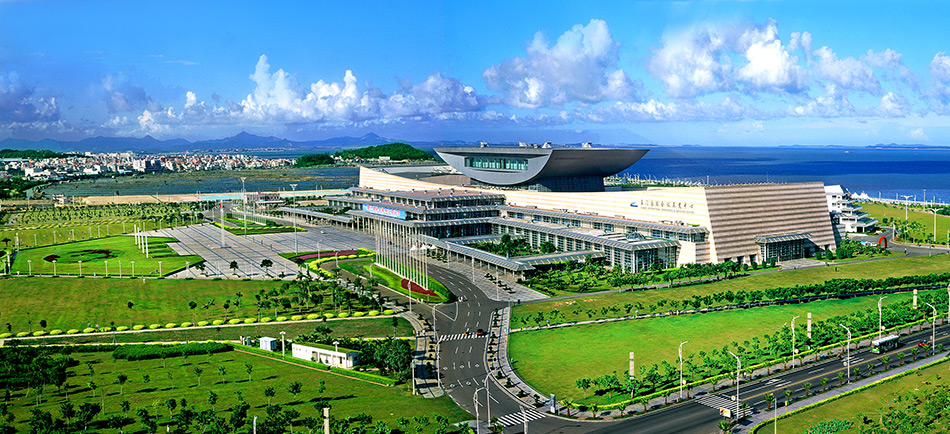
Visitors at the China International Fair for Investment and Trade in Xiamen, Fujian Province, on September 8, 2020 (XINHUA)

The Asia Plaza, a residential and commercial building in the Manila Bay Area of the Philippines, is one of the offshoots of the country's participation in the China International Fair for Investment and Trade (CIFIT) last year. With an estimated investment of $77 million, the project started construction in June, introducing 200 new jobs, according to the Philippine News Agency.

The country will be joining CIFIT 2021, set to take place from September 8 to 11 in Xiamen, Fujian Province, as the guest country of honor for the second year in a row. In the last edition, it featured 64 projects worth $1.07 billion. This time, the country aims to further attract investment in the fields of manufacturing, renewable energy and infrastructure.

CIFIT is China's only international investment promotion intended to facilitate trade and investment between Chinese and foreign companies.

While the coronavirus is still battering the global economy, the fair offers an important platform for companies to seek business opportunities. "More than offering a one-stop-shop service for multilateral investment cooperation, CIFIT will help [those seeking new opportunities] select from the widest array of investment projects and business partners from around the world," Ramon M. Lopez, Secretary of the Department of Trade and Industry of the Philippines, said.

Platform for cooperation

Based on the theme of New Opportunities for International Investment Under New Development Patterns, the upcoming event will revolve around the 14th Five-Year Plan (2021-25) of China, the BRICS Partnership on the New Industrial Revolution, the Belt and Road Initiative, and bilateral and multilateral cooperation, Wang Shouwen, Vice Minister of Commerce and Deputy China International Trade Representative, said at a press conference on July 20.

China has become the world's second largest consumer market and the largest trader in goods. After becoming the world's biggest recipient of foreign investment last year, paid-in foreign direct investment (FDI) into the Chinese mainland surged 25.5 percent year on year to more than 672 billion yuan ($100 billion) in the first seven months of this year, according to the Ministry of Commerce.

"This year's CIFIT will speak to China's investment environment and contribute to the world's economic recovery and growth," Wang elaborated. During the previous CIFIT, more than 2,300 projects were agreed upon, with a total investment of over $117 billion.

Circling back to 2011, the event's 15th edition saw the participation of all BRICS countries—Brazil, Russia, India, China and South Africa—for the first time. Since then, the fair has contributed multiple efforts to strengthening BRICS teamwork.

In 2015, several activities drawing inspiration from the Belt and Road Initiative took place as part of CIFIT, and it has since crafted a platform for cooperation among participating countries and regions.

Later, CIFIT 2016 emerged as a concrete step toward the implementation of the consensus reached during the 11th Summit of the Group of 20 (G20), hosted by China in early September. One of the main objectives there was to reinvigorate the two growth engines of trade and investment to provide a stronger driving force for worldwide economic growth.

Over the years, the fair had become one of the most influential international investment events, making positive contributions to China's reform and opening up as well as the country's socialist modernization, President Xi Jinping said in a congratulatory letter to CIFIT 2018.

Wang said activities such as the Silk Road Maritime International Cooperation Forum and the Belt and Road Development High Caliber Forum are to take place alongside this year's fair. Their goal is to better align various programs under the Belt and Road Initiative as well as encourage greater participation. The occasion will also see the establishment of a BRICS Partnership on the New Industrial Revolution pavilion.

A forum on cross-Taiwan Strait economic and trade cooperation will be held as part of CIFIT 2021, together with a series of activities such as an agricultural products fair, Guo Ningning, Vice Governor of Fujian, said.

Fujian, the Chinese mainland province geographically closest to Taiwan, features roughly 11,000 Taiwan-funded companies and their investment totals over $31 billion. CIFIT has become a bridge and an important strategic platform for the exchanges between the mainland and Taiwan, Guo added.

Major features

CIFIT 2021 will have an exhibition space of 110,000 square meters and host more than 100 activities, according to organizers. More than 800 delegations, 5,000 enterprises and some 100,000 enterprise representatives from 120 countries and regions will attend both online and offline.

The International Investment Forum is expected to feature government officials, renowned economists and representatives from Fortune Global 500 companies sharing their opinions on global trends.

Seminars and panel sessions will also brainstorm on the high-quality development of Chinese enterprises. The fair will publish a report on their overseas presence.

For the first time in its history, CIFIT will convene a conference of representatives from both Chinese and foreign investment promotion agencies. Its agenda also includes an innovation and development conference related to emerging industries, a forum on the improvement of China's business environment, as well as a session on China-U.S. provincial- and state-level green and low-carbon cooperation.

Moreover, a series of project-matchmaking activities will center on new-generation information technology, high-end equipment manufacturing, biotechnology, energy conservation and environmental protection, and the digital economy.

Upgraded online version

Following the 2020 edition, this year's CIFIT will once again be hosted both online and offline, as the COVID-19 pandemic still wields its influence worldwide.

"The online fair has gathered participants from all over China, as well as 38 foreign countries and regions," Chen Haoying, Deputy Director General of the Xiamen Municipal Bureau of Commerce and Director General of the Xiamen Municipal Bureau of Convention and Exhibition Affairs, said in May. The online platform will display investment environments, industrial information and policies as well as key investment projects, he added.

Further, through the online platform, users anywhere in the world can more easily partake in activities such as exhibitions, live-streaming, consultations and negotiations. It also comes with a customer relationship management system in which the information and business inquiries shared by its users will be collected to create a database to enhance analysis and overall service.

For example, with some Philippine enterprises unable to come to the site due to COVID-19 last year, visitors could scan the QR codes inside the pavilion to learn more about projects and products or step into the negotiating room and talk to people in the Philippines directly via video link.

This year's edition will see a refreshed and optimized online platform that can offer participants one-stop services, based on a wide range of digital implements that include mobile apps, social media and websites, Guo said. Business people and exhibitors can access all information and various services in a fast, convenient and efficient way through any online tools.

With this online version, CIFIT is gearing up to provide year-round exhibition and promotion services that can help boost global investment and trade, Wang concluded.


Xiamen: Open for Business

 XIAMEN HAS ALWAYS BEEN a little bit different. Although dozens of Chinese cities outrank it in terms of population and economic might, Xiamen eclipses most of them in reputation and importance.

Here the economic emphasis has always been on trade and finance. With less reliance on factories and heavy industry, one of the things that sets Xiamen apart is immediately clear. Literally. There is no pall of acrid smog. Looking across from the mainland, the skyline is sharply visible, in stark contrast to many other Chinese cities where pollution is sometimes so dense you struggle to see across the street.

White egrets on the lake shore in Xiamen

White egrets on the lake shore in Xiamen © KATOOSHA | DREAMSTIME.COM

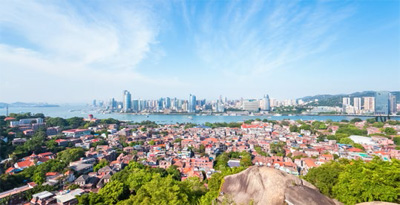
Another thing that sets the city apart, again literally, is geographic: It’s an island, situated in a bay and linked to the mainland by causeways, bridges and tunnels. Its sheltered waters and natural defenses, together with its strategic location on the coast of the southeast province of Fujian between Hong Kong and Shanghai, made Xiamen (then known as Amoy) a favored base for early foreign traders, and in the 19th century it became the leading port for exporting Chinese tea.

The foreign traders left their mark in the architecture. Unusually for China, Xiamen has largely preserved the colonial districts, especially around the downtown waterfront and on the small adjacent island of Gulangyu, providing this city with a unique character that incorporates Portuguese, British, Dutch and French influences.

Locals speak the Hokkien dialect of Chinese, widespread in Taiwan, Singapore, Indonesia and Malaysia but not so common in China itself. Xiamen remains the country’s largest Hokkien-speaking city. It is from the Hokkien dialect we acquired words such as ketchup, tea and typhoon.

The waterfront district makes the ideal place to start a day in Xiamen, and the historic Lujiang Harbourview Hotel provides one of the best options for accommodation. This colonial-style hotel, dating back to the 1950s, was once the tallest building in Xiamen. Although the island has since sprouted clusters of skyscrapers, none rival this venerable hotel for location.

The hotel’s top-floor (seventh-floor) Ocean-Observation Hall, with restaurant seating inside and out on the terrace, offers an excellent venue for business breakfasts. For a breakfast on the run, you’ll find plenty of coffee shops and cafés dotted around downtown, including branches of Starbucks.

The high-end address of choice is the Kempinski Hotel Xiamen (also a former holder of the city’s tallest-building mantle), located on the shore of Yundang Lake yet within easy distance of the main downtown venues. If you have local business contacts you need to impress, this is the place to do it.

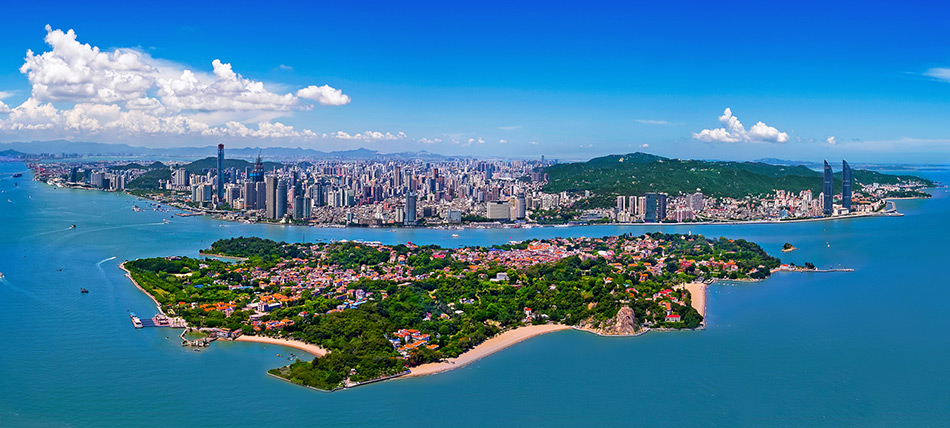
Aerial view from Gulangyu Island

Aerial view from Gulangyu Island © CHUYU | DREAMSTIME.COM

The early foreign settlers based themselves in an enclave on the one-square-mile island of Gulangyu, today undoubtedly Xiamen’s top attraction. For locals, a small ferry from downtown makes the crossing in just five minutes. All non-locals (including Chinese tourists) must use the ferry service from the Dongdu International Terminal; the crossing from there takes 20 minutes.

While the main island of Xiamen provides a relatively calm retreat from mainland China, Gulangyu takes it to extremes. The island’s cobbled streets and alleys are traffic-free: Cars — and even bicycles — are banned. The low-rise architecture is predominantly Victorian: stately brick residences with red-tiled roofs. This little island is widely regarded as the most scenic district in all of China.

Plenty of no-frills restaurants and cafés offer great Chinese food on Gulangyu. But if you’re playing host to business contacts, head to Ludwig Restaurant in the Miryam Boutique Hotel at the foot of the island’s famous Sunlight Rock (offering breathtaking views across to Xiamen). California chef Tomer Biran oversees the international fusion menu.

Back on the main island, the Marco Polo Xiamen Hotel has a long-established reputation as a venue for formal and informal business meetings. The Lobby Lounge makes an ideal setting for afternoon tea or early evening drinks. Seaview Resort, set within the greenery of the beautiful southern coast of Xiamen Island, offers a laid-back option for afternoon meetings. Take tea on the terrace overlooking the Taiwan Strait, or start the evening in the Jazz Bar.

For a wider range of options for business entertaining, head back downtown. The Fat Fat Beer Horse craft brewery sports a fun atmosphere — a good place to get things rolling. As for restaurants, it’s probably best to let your Chinese associates pick the venue if you’re eating local cuisine. For a refined international choice, you can’t go wrong with the Portofino Italian Restaurant at the Millennium Harbourview Hotel.

It’s not hard to appreciate why Xiamen often features at the top of lists of China’s most livable cities. This is China made easy: less frenetic, less polluted, more open, more relaxed. The pioneering foreign traders of the colonial age discovered it to be an excellent place in which to live and do business. It still is.

As a global city featuring bustling ports and abundant tourism, Xiamen has now emerged as the strategic fulcrum of the Maritime Silk Road

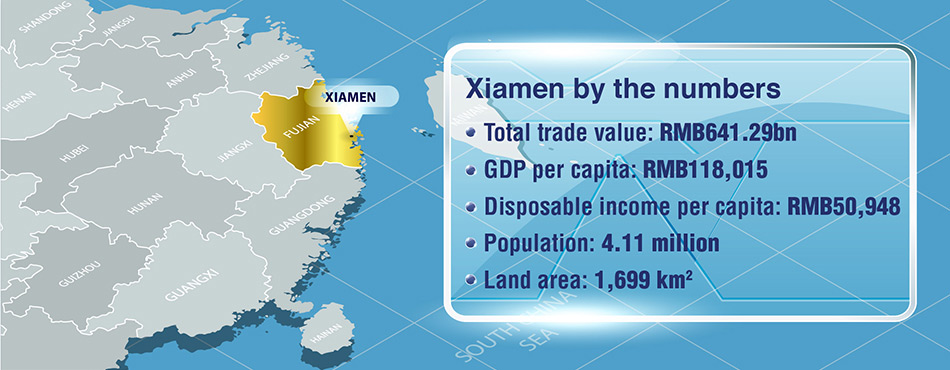
 Located on the west of the Taiwan Strait, Xiamen is a sub-provincial city of the Fujian Province and a city specifically designated in the state plan. The city covers an area of 1,699.39 square kilometres with a population of 4.11 million people. It was one of the first four Special Economic Zones that pioneered the reform and opening-up policies in Mainland China.


Dynamic development
Four decades of reform and opening-up have seen GDP in Xiamen grow at an average annual rate of 15.4 per cent, while that of government revenue is registered at 18.5 per cent. With much promise in innovation and entrepreneurship, Xiamen ranks top of the nation in terms of aggregate revenue, per capita GDP, per capita government revenue, and foreign trade competitiveness. High- and new- technology emerged as a core industry in the city, with nearly 70 per cent of industrial added value of above-scale enterprises coming from companies in this category. Xiamen is a top-tier international transport hub and one of the four international shipping centres in Mainland China. It is no wonder that it is considered one of the best cities in the country for entrepreneurship, ranking second among the pilot cities in Mainland China in ease of doing business.

Pioneering endeavours
Facing the ocean, Xiamen is naturally one of the points of departure of the 21st Century Maritime Silk Road. It boasts an outward facing economy brimming with bright prospects. As a national-level Special Economic Zone, Xiamen has a talented pool of professionals and advanced technology well-prepared to quickly grow its economy. The municipal government also makes great effort to create a first-class market-oriented economy and level playing field for enterprises to prosper.
Advantageous location
  • Xiamen faces the Taiwan Strait on the east and is connected to the Pearl River Delta and the Yangtze River Delta on the south and north, both of which are essential to the country’s economy.
  • The Beijing-Kowloon Railway links Xiamen to the vast hinterlands of inland provinces such as Jiangxi, Hunan and Hubei.
  • Xiamen is a hub that seamlessly connects different cities and regions along the Maritime and Land Silk Road. It plays an important role in strengthening exchanges in economic, cultural and human resources.
  • Xiamen is the only special economic zone in Mainland China “established especially for Taiwan”. It looks to encourage cross-strait co-operation and stands as the gateway to the mainland for Taiwanese businesses.
  • The Port of Xiamen connects to international shipping routes that cover 129 ports in 48 countries and regions.

Regional and international transportation hub
Xiamen’s geographical advantages and sound infrastructure guarantee swift transportation from the city to surrounding areas and far beyond.
  • Convenient air traffic: As one of the six major airports in Mainland China, Xiamen Airport now operates 171 air routes, including 35 international routes and six intercontinental routes, providing access to Australia, Canada, the Netherlands, the US and 28 international cities including Hong Kong, Macao, Taipei and Kaohsiung. Xiamen offers “144-hour visa-free transit” for travellers from designated countries.
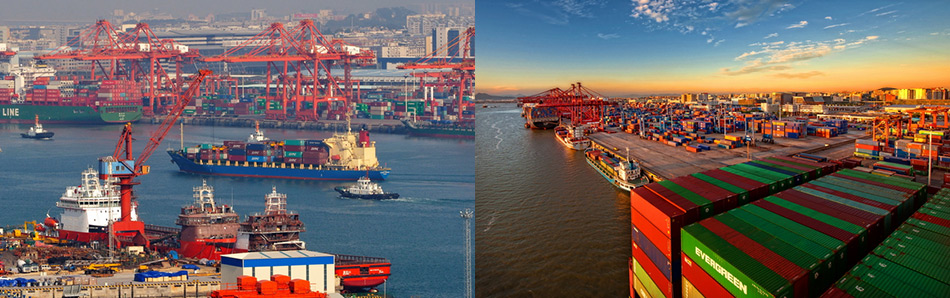
  • Developed shipping hub: Xiamen is one of Mainland China’s four major international shipping centres and is also a logistics centre in the southeastern part of the country. There are 146 container lines, including 92 international lines, of which 57 link up nations along the Maritime Silk Road. The Port of Xiamen has 165 berths, of which 76 have a capacity above ten thousand tonnes.
  • Efficient transportation hub: Expressway and highway networks link Xiamen seamlessly with other transportation networks in the central and western parts of Mainland China. Augmented by railway networks, transportation time to Shanghai, Shenzhen and Fuzhou is shortened to five, three and two hours,
  • China (Xiamen) – Europe train: Xiamen is the only land and sea transportation hub that connects “the Belt” and “the Road”. International freight trains to 12 countries and 34 cities in Europe, Central Asia and Russia are in operation.

Key industries
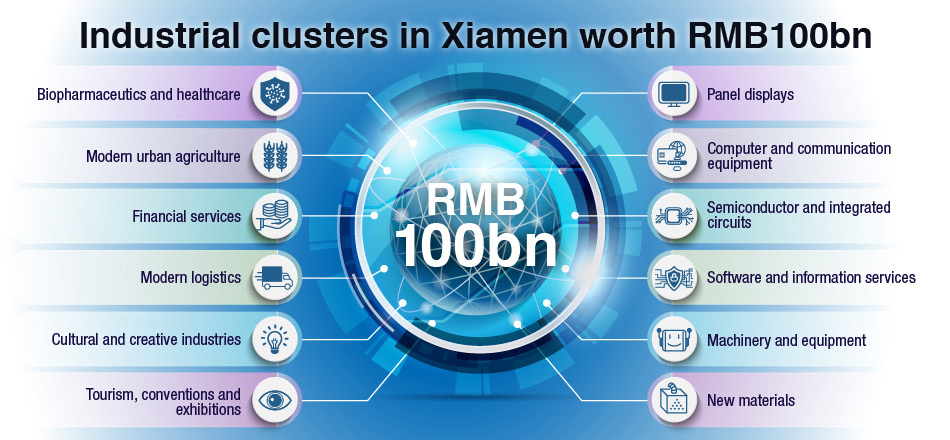
Based on local resources and designated functions, Xiamen focuses on developing five industrial clusters, including electronic information, equipment manufacturing, tourism, modern logistics and financial services. In order to improve comprehensive industrial competitiveness, the city strives to nourish more than 10 industrial clusters that are each worth RMB100bn. These include panel displays, computer and communication equipment, semiconductor and integrated circuits, machinery equipment, biopharmaceutics and healthcare, new materials, tourism, conventions and exhibitions, modern logistics, software and information services, financial services, cultural creativity and modern urban agriculture.

Trade performance
  • In 2019, Xiamen recorded a total trade value of RMB641.29bn, representing a growth of 6.9 per cent and 48.2 per cent of Fujian Province’s total trade value, placing the city at the forefront of the province in terms of trade performance. While exports grew 5.7 per cent to RMB352.87bn, imports grew 8.3 per cent to RMB288.42bn.
  • Xiamen’s imports from and exports to countries along the Belt and Road Initiative are also growing well. Imports and exports totalled RMB202.19bn, representing an increase of 14.4 per cent and accounting for 31.5 per cent of Xiamen’s total trade over the same period. The pace of market diversification is steadily advancing.
  • The Philippines, Vietnam and Indonesia are Xiamen’s top three export partners, while the top three import partners are Indonesia, Malaysia and Vietnam. Imports from and exports to certain countries have recorded exceptionally strong growth, as seen in both imports from and exports to Oman that increased by 7.8 times, to Ukraine by double, and to Uzbekistan by 92.5 per cent.


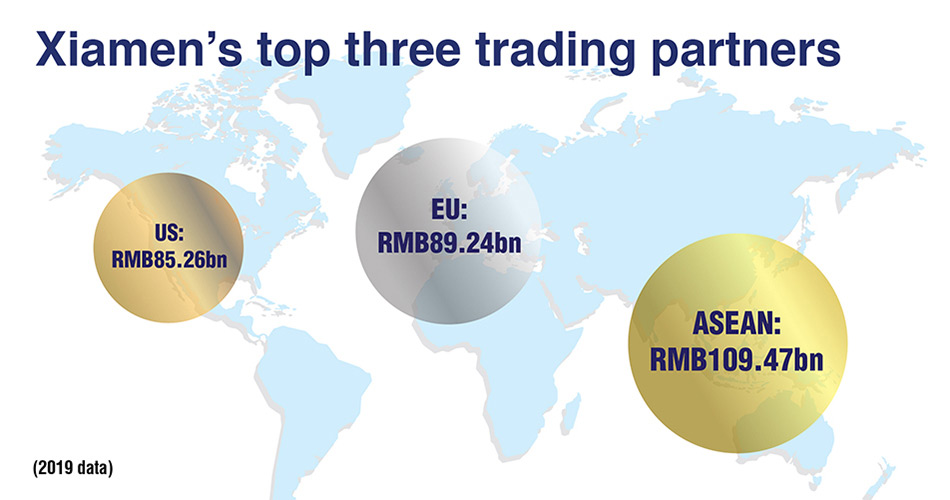
  • ASEAN, the EU and the US are the top three trading partners of Xiamen. In 2019, Xiamen’s imports from and exports to these three regions amounted to RMB109.47bn, RMB89.24bn and RMB85.26bn, respectively. During the same period, imports from and exports to these regions accounted for 44.3 per cent of Xiamen’s total trade value.
  • Xiamen exported RMB169.25bn of mechanical and electrical products in 2019—an increase of 3.9 per cent—which accounted for nearly half of the export value. Exports of labour-intensive products remained robust. The city exported RMB119bn worth of textiles, clothing, footwear, toys, plastic products, bags and furniture, representing an increase of 12.2 per cent and accounting for 33.7 per cent of the city’s exports. In terms of imports, iron ore, coal, copper ore and other natural resources accounted for a relatively large proportion.

Xiamen FTZ achieves high-quality development through reform, opening-up

 1224.png

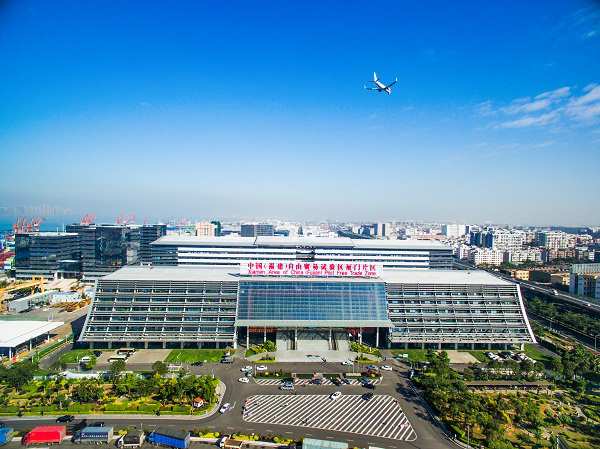
An aerial view of the Xiamen Area of the China (Fujian) Pilot Free Trade Zone.

Since its establishment on April 21, 2015, the Xiamen Area of the China (Fujian) Pilot Free Trade Zone has been boosting its high-quality development through reform and opening-up.

Over the past six years, the regional GDP has increased by 13.5 percent, the total import and export has increased by 11.4 percent, and the fiscal revenue has increased by 10.6 percent.

Xiamen FTZ has launched 498 innovative practices, including 111 national initiatives. Thirty innovations have been promoted nationwide, accounting for one-fifth of the national total.

Xiamen FTZ is committed to creating a world-class business environment.

It has deepened the reform of the commercial system and administrative system as well as explored new ways to protect intellectual property rights. It also took the lead in reducing costs and improving import and export efficiency, and built a transparent and efficient legal system.

"Forty years of reform and opening-up in Xiamen Special Economic Zone laid the foundation for our business environment," said Dai Bin, a Xiamen FTZ official. "Since the establishment of the Xiamen Area of Fujian FTZ, we have established international rules and regulations as well as benchmarked the highest international standards to liberalize and facilitate investment and trade."

A total of 46,000 newly registered enterprises have been added in the zone since 2015, with registered capital exceeding 680 billion yuan ($106.82 billion). The number of enterprises in the zone has grown six times since the zone was established.

In order to build itself into the "first home" for Taiwan compatriots and Taiwan enterprises, the Xiamen FTZ has stepped up the cross-Straits integrated development by building a cross-Straits youth innovation and entrepreneurship base and has set up cross-Straits maritime express pilot areas. To date, 1,036 Taiwan-based enterprises have become operational in the zone.

The zone has also continued to expand opening-up to the outside world. It has worked on building a cooperation mechanism with countries and regions along the Maritime Silk Road to form a wider and deeper relationship with them.

To boost the digital economy, the Xiamen FTZ has promoted the construction of a digital free trade zone and trade digitization.

It has also ramped up efforts to bolster its 14 key platforms including aviation maintenance, financial leasing, and cross-border e-commerce to generate an industrial agglomeration effect and spur economic growth.

Siming district transforms into epitome of Xiamen's opening-up, development


Siming district transforms into epitome of Xiamen's opening-up, development

Siming district in Xiamen, East China’s Fujian province boasts thriving businesses and is home to the city's busiest business area. [Photo/WeChat account: fjrbwx]

Siming district in the coastal city of Xiamen, East China's Fujian province has seen profound and transformative change over the past 40 years since the establishment of the Xiamen Special Economic Zone.

The district, which is situated in the central urban area of Xiamen, boasts thriving businesses and is home to the city's busiest business area.

Xiamen Hualian Commercial Building, which is located on Zhongshan Road in Siming, used to be considered the largest comprehensive retail mall in Fujian province in the 80s and 90s. The commercial building opened to the public in 1987, and was regarded as a "shopping paradise" by local residents.

Standing at the most prominent position on Zhongshan Road, Xiamen Hualian Commercial Building has witnessed major development of Xiamen's commerce and trade over the past decades.

In recent years, Siming has explored new ways to foster new business models and tactics with a number of new commercial complexes springing up, and efforts have also been made in the transformating and upgrading old business districts.

At the same time, new industrial parks with leading industries and superior enterprises have been set up thanks to the local government's efforts.

Xiamen Software Park in Siming has boosted its development opportunities over the years and has become an industrial landmark of Xiamen with a slew of high-tech businesses and innovation incubators.

The park is home to a group of renowned companies across a range of fields such as the information safety company Meiya Pico, the facial recognition enterprise Meitu, healthcare tech company YLZ Information Technology, and animation giant Migu. The total business revenue of Siming's software industry amounted to 29.3 billion yuan ($4.6 billion) in 2020, and four enterprises in the park made China's top 100 internet companies list.

Wang Huibin, vice-president of Meitu, spoke highly of Siming's business environment and said that Siming offers fertile soil for innovation and entrepreneurship for high-tech, high-growth, and high-added value enterprises.

Taking up five percent of Xiamen's land and a quarter of its population, Siming recorded one-third of the city's total GDP. Currently, the district has cultivated four industrial chains valued at 100 billion yuan, which are finance, commerce and trade, software and information, and tourism and MICE (meetings, incentives, conferencing and exhibitions).

At the same time, Siming has been ramping up efforts to accelerate the development of emerging industries, and aims to inject new vitality into the district's development.


Marine Economy Set to Boom in Xiamen During 14th Five-Year Plan Period

 XIAMEN, China, November 26, 2021--(BUSINESS WIRE)--

Xiamen’s marine economy is expected to embrace high-quality development during the 14th Five-Year Plan period (2021-25) as it has recently been guaranteed a leading city status in developing marine sectors in East China’s Fujian province.

The municipal government released two development plans, which noted that efforts should be made to enhance its role in bolstering the province's marine economy.

According to the plans, Xiamen will set up strategic emerging marine industrial clusters by promoting the commercialization of scientific and technological achievements.

Efforts will be made to speed up the construction of a national demonstration zone for the marine economy. Marine biological industries will also be cultivated, and build global supply bases for marine products.

Xiamen will foster new drivers of growth for marine economy, such as building itself into a Southeast International Shipping Center and improving the efficiency of the ocean shipping transportation system.

The plan noted that as of 2023, Xiamen will set up a modern marine industrial system supported by emerging marine industries, modern fisheries, port logistics, and high-end coastal tourism.

The local government has also stepped up efforts to improve basic research capability, and build a batch of marine scientific research institution. A wide range of supportive measures have been rolled out to further stimulate the vitality of scientific and technological innovation.

A high-tech industrial park for marine industry is expected to be built in Xiamen, which will push forward the development of high-end marine industries.

Supported by strong scientific and technological prowess, the output value of Xiamen’s marine industry will reach 300 billion yuan by 2025, which is estimated to account for 30 percent of the city's total GDP.

As a key port city of the 21st Century Maritime Silk Road, Xiamen will beef up efforts to attract world-class marine enterprises and core technologies, encourage Xiamen enterprises to go abroad, and deepen opening-up and cooperation in the marine economy.

The city will develop itself into a world-class port, an international coastal tourism city, an ocean cultural exchange center for countries and regions involved in the Belt and Road Initiative, as well as a global model for marine ecological governance.

View source version on businesswire.com: https://www.businesswire.com/news/home/20211126005477/en/

Sunday, February 20, 2022

Xiamen a Hotbed for Investment

 XIAMEN, China, April 29, 2021 /PRNewswire/ -- This is a news report from China Daily:

A global investment promotion conference marking the 100th anniversary of the founding of Xiamen University was held in Xiamen, East China's Fujian province, on April 7.

Agreements for 32 major industrial projects were inked, involving a combined investment of 43.9 billion yuan ($6.7 billion). Eleven of the projects are worth more than 1 billion yuan each and cover various fields such as semiconductors, bio-medicine, hotels, and modern logistics.

A program to encourage XMU's alumni to invest in Xiamen was also launched at the conference, aiming to attract the alumni to contribute to the city's high-quality development by bringing in more resources.

Since the program was initiated in September 2020, 511 projects led by XMU's alumni had signed up for the program by April 5, involving a combined investment of 164.72 billion yuan.

"Xiamen boasts a favorable environment for living and starting businesses," said Zhao Haiying, an alumna of XMU and chairwoman of Femisci, a beauty and healthcare company.

Zhao, cooperating with SignalChem Lifesciences Co, a Canada-based clinical-stage company, signed an agreement to set up the company's China headquarters in Xiamen's Haicang district. It will include research and development platforms for protein engineering technology, and targeted therapies.

"Considering the strong scientific research capacity of XMU and the solid foundation of Xiamen's biomedicine industry, I have full confidence in the future development of our project," Zhao added.

A pioneer in attracting investment

As one of the country's first four special economic zones and a key hub along the 21st Century Maritime Silk Road, Xiamen has led China in reform and opening-up, becoming a pioneer in attracting investment and innovating its economy.

The city signed 8,411 projects with a combined investment of 1.6 trillion yuan in 2020. It also led Fujian province in the actual use of foreign capital, which accounted for 47.7 percent of the province's total.

Chinese startup Lixiang, also known as CHJ Automotive, and Tencent Cloud, the cloud computing unit of Chinese tech giant Tencent, also set up subsidiaries in Xiamen recently.

"We have eyed the high-end and new economy industries due to limited land (Xiamen covers an area of some 1,700 square kilometers)," said Huang Heming, director of the city's commerce bureau, in an interview with ThePaper, a Shanghai-based online news portal.

To attract investment, the local government has spared 1,335 hectares of land for industrial use and 2.96 million square meters of office buildings for the modern service industry. The city also offers tailored solutions for industrial companies in terms of land use and leads the country in speeding up related administrative procedures.

A city of the new economy

Behind Xiamen's economic growth are mainly 12 industrial chains, each with a value of at least 100 billion yuan.

"We are building a city of the new economy," said Huang.

The city has seen increasing capacity for independent innovation in high-end manufacturing industries, such as flat-panel displays, semiconductors, and integrated circuits, as well as new materials, as projects like MicroLED R&D center sponsored by TCL China Star Optoelectronics Technology Co and the Cross-Strait Tsinghua Research Institute signed or started operating.

As one of the cradles of China's internet and games, Xiamen's software industry generated 197.2 billion yuan in revenue last year, accounting for nearly 58 percent of the provincial total. Among its 10 listed companies, five are among the top 100 internet companies in China.

In addition, booming strategic emerging industries have also become a highlight of Xiamen's growth. Taking the biomedicine sector as an example, the city currently has a dozen national laboratories, 297 national high-tech companies, and 10 listed companies, with a combined revenue of nearly 100 billion yuan.

Breakthroughs have also been made in attracting investment in the film, television, and culture industries, as industrial leaders like news portal Toutiao, podcast app Himalaya FM and box office tracker Maoyan have set up operations in Xiamen.

The new economy characterized by the digital economy is taking shape, with 79 projects worth 27.6 billion yuan settling in the city.

Xiamen has adhered to the concept of "creating a market for investment" to accelerate the growth of its new economy.

The local government has encouraged the information technology, education, health, urban management, transportation, and public security departments to offer abundant application scenarios and policy support to new business models focusing on big data, artificial intelligence, and the sharing economy.

The city has also seized development opportunities in the post-pandemic era, with several infrastructure projects involving 5G technology, big data, AI, and online medical treatment being signed or starting operations.

SOURCE China Daily