Saturday, June 15, 2019

NTERNATIONAL SCHOOLS IN XIAMEN, FUZHOU CHINA

People's Daily: Fujian FTZ 4

Manila Xiamen International School
Address: 735 Long Hu Shan Lu, Zeng Cuo An, Shi Ming District, Xiamen 361005, China
Postal Area Code: Xiamen 361005
Telephone: 86 59 2251 6370
Email: mxis@public.xm.fj.cn
Website: http://www.mxis.org/ 
Info: Nursery School (age 3-5) Primary School (age 6-10) Middle School (age 11-16) High School (age 17-18)

Xiamen International School
Address: 262 Xinglin North 3rd Rd, Jimei, Xiamen 361022, Fujian, China
Postal Area Code: Xiamen 361022
Telephone: 86 59 2625 6581
Email: askxis@xischina.com.cn 
Website: http://www.xischina.com/ 
Info: Nursery School (age 3-5) Primary School (age 6-10) Middle School (age 11-15) High School (age 16-18)


Fuzhou Lakeside International School
No.72 Meng Shan Road, Gulou District Fuzhou, Fujian Province, China
地址:中国福建省福州市鼓楼区北梦山路72号

One-stop services for foreign investing in Fujian China,offer business setup consulting,company registration,accounting services,foreign investment legal services in Fujian


Image result for fujian map
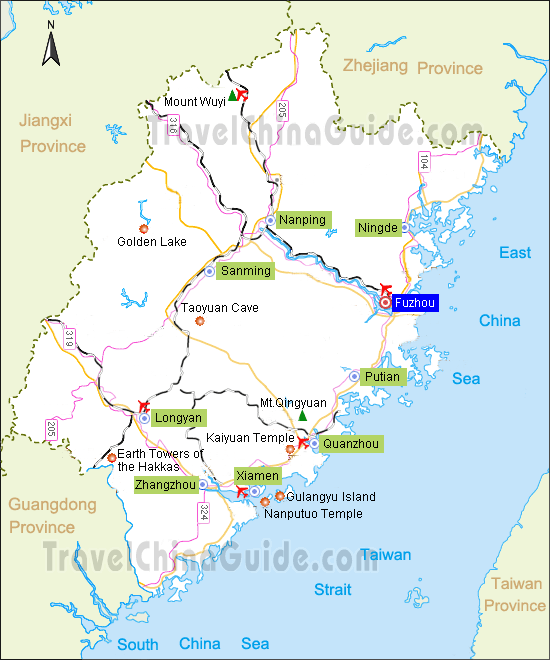
Lying in the southeastern coast of China and bordering Zhejiang Province, Jiangxi Province and Guangdong Province, Fujian is facing Taiwan across the Straits and one of the closest mainland provinces to South east Asia and Oceania, as well as an important window and base of China for global exchanges. Boasting a long history, Fujian was called the Region of Minyue during the Spring and Autumn Period and the Prefecture of Min-Zhong during Qing Dynasty. In the middle of Tang Dynasty, the post of Fujian Military Commissioner was established, and the province was hereafter called Fujian. The brief name of Fujian, "Min", is derived from Min River, the greatest river within the province. Covering a land area of 121,400 square kilometers and a sea area of 136,000 square kilometers, Fujian governs Fuzhou, Xiamen, Quanzhou, Zhangzhou, Putian, Longyan, Sanming, Nanping and Ningde (nine municipal cities), as well as 85 subordinated counties, cities and districts (including Jinmen County).
 Image result for fujian

To facilitate people who want to invest and set up business in Fujian, here is an introduction of Types of business presence in China: 

Before starting up a business in China, you have to know what are the options. Foreign Investors generally establish a business presence in China in one of five modes: Wholly Foreign Owned Enterprise (WFOE); Representative Office; Foreign Invested Partnership Enterprises (FIPE); Joint Venture and Hong Kong Holding Company.

Wholly Foreign Owned Enterprise( WFOE) is a Limited liability company wholly owned by the foreign investor. WFOE requires no registered capital and it's liability of equity , can generate income, pay tax in China and it's profit could be repatriate back to investor's home country. Any enterprise in China which is 100 percent owned by a foreign company or companies can be called as WFOE.

Representative Office (RO) is a Liaison Office of it's parent company. It requires no registered capital. It's activities would be: product or service promotion, market research of it's parent company's business, Quality Control liaison office etc in China. RO generally is prohibited to generate any revenue nor generating contracts with local businesses in China.

Joint Venture (JV) is a Limited liability company formed between Chinese investor and Foreign investor. The parties agree to create a entity by both contributing equity, and they then share in the revenues, expenses, and control of the enterprise. JV usually been used by foreign investor to engage the so called restricted in areas such like: Education, Mining, Hospital etc.

Since March 1, 2010, Measures of Establishment of Foreign Invested Partnership Enterprises (FIPE) in China is taking effect. The regulation, which take effect since March 1, 2010, are known as the Administrative Measures for the Establishment of Partnership Enterprise in China by Foreign Enterprises or Individuals. There's no required minimum registered capital for a Foreign Invested Partnership Enterprise (FIPE) in Fujian, Beijing, Fujian, Shenzhen, Hangzhou and rest cities of China

Hong Kong Company usually been used as a Special Purpose vehicle (SPV) to invest Mainland China. Hong Kong is one of the quickest locations to Incorporate a business. Although a HK company is not a legal entity in Mainland China (Mainland China and Hong Kong, See Wiki 1 country, 2 systems), lots foreign investors, especially investors from Europe and North America still chose to setting up a Hong Kong company as SPV to invest China.

After China's entry to WTO, most industries in China welcome foreign investment, WFOE setting up in China becomes the first option of foreign investment's entity structures instead of Rep.Office setting up in China. At the mean time, for tax purpose, effective licensing system etc more and more investors use Hong Kong as the holding company to invest China mainland, using this offshore company to hold their operations in China.

Business set-up in Fujian is a big project by itself, which requires financial and time commitments, business management knowledge and China expertise. Identifying a competent agent to manage the complex process will be a cost and time effective way to avoid potential pitfalls . Tommy China Business Consulting has direct connections in the local government

Since 2006, TCBC has been focusing on consulting services for our clients to invest in Fujian China. We are specialized in establishment of wholly foreign owned enterprises (WFOEs), setting up of offshore companies, trading services, tax minimization, Assist in obtaining government approvals and certificates for running business,negotiate and draft various legal documents provide legal advice, negotiate government officer for Land acquisition. Advising on formation of WOFE and business structures, managing and controlling WOFE in Fujian China, drafting privacy policies and structuring commercial transactions

TCBC will manage all aspects of incorporation to get you a business license in Fujian  China. We offer a range of company formation services including helping you to set up:
-Joint Ventures (Equity/Co-operative)
-Foreign Invested Partnership Enterprises (FIPE)

Once your business is officially registered in Fujian, it's required to maintain proper accounting records in accordance with accounting standards in China and to report taxes on both monthly (for business tax, individual income tax) and quarterly (corporate income tax) basis. Late submissions will face penalties and surcharges.

When foreign companies come to Fujian to set up Small Medium Enterprises, one of the headaches is to find an English-speaking professional accounting & tax advisory and agency firm. Even there is help from local professionals, due to language and communication problems, it is still hard for investors to find the correct way of investment and to completely understand the local investment and tax policy. Furthermore, it is hard for the foreign investors to set up a complete and legal financial & tax system as well as the related procedures. Therefore, different kinds of incompliant problems regarding tax and legal areas will be accumulated with the invested company and lead to serious legal risks step by step.

A lucky investor may get the fluent English-speaking internal accountant by recruitment, but it does not mean the invested company no longer needs an external consultant. Due to the professional limitation of internal accountant, particularly when it comes to comprehensive issues regarding taxation, customs, foreign exchange, labor, banks and so on, it is hard for the internal accountant to propose sophisticated professional advice and options to the company’s management.

During the practical operating, many small and medium sized companies conclude that full time cashier and full time accountant cost a lot and create certain burden for operation. Meanwhile, as they might not be full occupied by works due to the limited work load. To be successful, any enterprise regardless its size often needs a financial and accounting expertise.Outsource your accounting project to us is the best solution to this problem.  With Our professional accounting service, clients can have the expertise they require when they require.

Our accountant could assist you and negotiating with your local officer to use the proper tax reporting method for your China presence. And submit the tax reports monthly and quarterly on your behalf.
.
The details of our services are set out below
Update the books in accordance with the Chinese Accounting Standards
Prepare monthly financial statements for tax filing purpose and submit if applicable
File monthly Business Tax Return and Individual Income Tax Return
File Corporate Income Tax Return quarterly
Annual Corporate Income Tax Filing
Monthly Bookkeeping Service
Audit of Financial Statements

Foreign companies come in contact with the Chinese legal system the moment they decide to doing business with china. Our legal teams have served the clients in Fujian China since 1990s. We have advised on some significant investments, international trades, real estate projects, arbitration, litigation and individual needs to date. The expertise we have allows us to place ourselves at your full disposal to offer our advisory services in China, to suggest the best path to lead you to the best solutions for any challenge in your business. 

We have extensive experience with the entire spectrum of business entities in China, from simple Representative Offices to more complex Foreign Invested Enterprises such as Wholly Owned Foreign Enterprises (WOFEs) and Joint Ventures (JVs). We have served hundreds of clients from more than 30 countries in virtually every industry sector. Our consultants have developed an extensive network of local connections to expedite business registration projects and to negotiate for favorable incentives for large Foreign Direct Investment (FDI) projects.

We assist our clients with their China projects regardless of which stage of development they are in, like researching the business environment, entering the market or already growing their business within China. We are committed to guiding our clients through the challenges of achieving their goals by not only keeping them abreast of current trends but also anticipating how those trends may impact the market they are in. We customize our approach according to our clients’ specific needs.


Quanzhou Profile, Incorporate Business,Company Registration,Corporate Formation In Quanzhou

Quanzhou
Quanzhou is located on the southeast coast of Fujian province and faces the Taiwan Straits. It was among the first group of famous historical and cultural cities designated by the State Council. Quanzhou was also an important harbor and starting point of the Maritime Silk Road. It is the ancestral home of many overseas Chinese.

Quanzhou covers 11,015 squre meter of land surface and 11,360 square meter of oceanic area. Its resident population reached over 8.65 million in 2017. It has four districts, three county-level cities, five counties - and also includes the Quanzhou Economic & Technological Development Zone.

The city has a subtropical marine monsoon climate, a coastline of 541 kilometers, and 58.7 percent of its area is covered by forest. It boasts rich mineral resources such as iron, manganese, gold, coal and quartz. The port of Quanzhou has facilities in four bays of the Taiwan Strait.

Visitors to the city can still see traditional Chinese temples and opera houses, and there are also 686 historical and cultural sites, including 20 sites under state protection, such as Kaiyuan temple, Anping bridge and Chonggu ancient town.

In 2017, Quanzhou's GDP amounted to 754.8 billion yuan, an uptick of 8.4 percent over the previous year, official statistics show.

Quanzhou Business Formation also can be understood as: Quanzhou company setup, Quanzhou corporate formation, Quanzhou business setup, Quanzhou company registration, Quanzhou business establishment and Quanzhou business registration.

To facilitate people who want to invest and set up business in Quanzhou, here is an introduction of Types of business presence in China: 

Before starting up a business in China, you have to know what are the options. Foreign Investors generally establish a business presence in China in one of five modes: Wholly Foreign Owned Enterprise (WFOE); Representative Office; Foreign Invested Partnership Enterprises (FIPE); Joint Venture and Hong Kong Holding Company.

Wholly Foreign Owned Enterprise (WFOE)is a Limited liability company wholly owned by the foreign investor. WFOE requires no registered capital and it's liability of equity , can generate income, pay tax in China and it's profit could be repatriate back to investor's home country. Any enterprise in China which is 100 percent owned by a foreign company or companies can be called as WFOE.

Representative Office (RO) is a LiaisonOffice of it's parent company. It requires no registered capital. It's activities would be: product or service promotion, market research of it's parent company's business, Quality Control liaison office etc in China. RO generally is prohibited to generate any revenue nor generating contracts with local businesses in China.

Joint Venture (JV) is a Limitedliability company formed between Chinese investor and Foreign investor. The parties agree to create a entity by both contributing equity, and they then share in the revenues, expenses, and control of the enterprise. JV usually been used by foreign investor to engage the so called restricted in areas such like: Education, Mining, Hospital etc.

Since March 1, 2010: Measures ofEstablishment of Foreign Invested Partnership Enterprises (FIPE) in China istaking effect. The regulation, which take effect since March 1, 2010, are known as the Administrative Measures for the Establishment of Partnership Enterprise in China by Foreign Enterprises or Individuals. There's no required minimum registered capital for a Foreign Invested Partnership Enterprise (FIPE) in Shanghai, Beijing, Shenzhen, Hangzhou and rest cities of China

Hong Kong Company usually been used as aSpecial Purpose vehicle (SPV) to invest Mainland China. Hong Kong is one of the quickest locations to Incorporate a business. Although a HK company is not a legal entity in Mainland China (Mainland China and Hong Kong, See Wiki 1 country, 2 systems), lots foreign investors, especially investors from Europe and North America still chose to setting up a Hong Kong company as SPV to invest China.

After China's entry to WTO, most industries in China welcome foreign investment, WFOE setting up in China becomes the first option of foreign investment's entity structures instead of Rep. Office setting up in China At the mean time, for tax purpose, effective licensing system etc more and more investors use Hong Kong as the holding company to invest China mainland, using this offshore company to hold their operations in China.

Business set-up in China is a big project by itself, which requires financial and time commitments, business management knowledge and China expertise. Identifying a competent agent to manage the complex process will be a cost and time effective way to avoid potential pitfalls

Since 2006, TCBC has been focusing on consulting services for our clients to invest in Quanzhou China. We are specialized in establishment of wholly foreign owned enterprises (WFOEs), setting up of offshore companies, trading services, tax minimization, Assist in obtaining government approvals and certificates for running business,negotiate and draft various legal documents provide legal advice, negotiate government officer for Landacquisition. Advising on formation of WOFE and business structures, managing and controlling WOFE in Quanzhou China, drafting privacy policies and structuring commercial transactions

TCBC will manage all aspects of incorporation to get you a business license in Quanzhou China. We offer a range of company formation services including helping you to set up:
-Joint Ventures (Equity/Co-operative)
-Foreign Invested Partnership Enterprises (FIPE)


Contact Tom Lee for business setup consulting in Quanzhou now.

Brief Introduction To Fuzhou,Set Up Business,Company Registration,Corporate Formation In Fuzhou

Fuzhou
Fuzhou, capital city of Fujian province, is located in the east of Fujian. When China initiated its reform and opening up drive in the 1980's. Fuzhou became one of the first coastal cities to open up to the outside world. The history of Fuzhou dates back 2,200 years, and it covers an area of 12-thousand square kilometers. There are six administrative districts, one county-level towns and six counties. In 2017, the resident population in Fuzhou reaches 7.66 million. It has a subtropical marine monsoon climate, and an average temperature of about 19.6. The jasmine is the city flower and the banyan is its city tree.

Fuzhou is the mainland provincial capital nearest to Taiwan. It has been called the most competitive city of manufacturing in China, one of the 200 most attractive cities in the world, and the eco-city in China with the highest investment value.

In 2017, Fuzhou's GDP registered 710.4 billion yuan, up 8.7 percent year-on-year, official data shows.

Fuzhou Business Formation also can be understood as: Fuzhou company setup, Fuzhou corporate formation, Fuzhou business setup, Fuzhou company registration, Fuzhou business establishment and Fuzhou business registration.

To facilitate people who want to invest and set up business in Fuzhou, here is an introduction of Types of business presence in China: 

Before starting up a business in China, you have to know what are the options. Foreign Investors generally establish a business presence in China in one of five modes: Wholly Foreign Owned Enterprise (WFOE); Representative Office; Foreign Invested Partnership Enterprises (FIPE); Joint Venture and Hong Kong Holding Company.

Wholly Foreign Owned Enterprise (WFOE)is a Limited liability company wholly owned by the foreign investor. WFOE requires no registered capital and it's liability of equity , can generate income, pay tax in China and it's profit could be repatriate back to investor's home country. Any enterprise in China which is 100 percent owned by a foreign company or companies can be called as WFOE.

Representative Office (RO) is a LiaisonOffice of it's parent company. It requires no registered capital. It's activities would be: product or service promotion, market research of it's parent company's business, Quality Control liaison office etc in China. RO generally is prohibited to generate any revenue nor generating contracts with local businesses in China.

Joint Venture (JV) is a Limitedliability company formed between Chinese investor and Foreign investor. The parties agree to create a entity by both contributing equity, and they then share in the revenues, expenses, and control of the enterprise. JV usually been used by foreign investor to engage the so called restricted in areas such like: Education, Mining, Hospital etc.

Since March 1, 2010: Measures ofEstablishment of Foreign Invested Partnership Enterprises (FIPE) in China istaking effect. The regulation, which take effect since March 1, 2010, are known as the Administrative Measures for the Establishment of Partnership Enterprise in China by Foreign Enterprises or Individuals. There's no required minimum registered capital for a Foreign Invested Partnership Enterprise (FIPE) in Shanghai, Beijing, Shenzhen, Hangzhou and rest cities of China

Hong Kong Company usually been used as aSpecial Purpose vehicle (SPV) to invest Mainland China. Hong Kong is one of the quickest locations to Incorporate a business. Although a HK company is not a legal entity in Mainland China (Mainland China and Hong Kong, See Wiki 1 country, 2 systems), lots foreign investors, especially investors from Europe and North America still chose to setting up a Hong Kong company as SPV to invest China.

After China's entry to WTO, most industries in China welcome foreign investment, WFOE setting up in China becomes the first option of foreign investment's entity structures instead of Rep. Office setting up in China At the mean time, for tax purpose, effective licensing system etc more and more investors use Hong Kong as the holding company to invest China mainland, using this offshore company to hold their operations in China.

Business set-up in China is a big project by itself, which requires financial and time commitments, business management knowledge and China expertise. Identifying a competent agent to manage the complex process will be a cost and time effective way to avoid potential pitfalls

Since 2006, TCBC has been focusing on consulting services for our clients to invest in Fuzhou China. We are specialized in establishment of wholly foreign owned enterprises (WFOEs), setting up of offshore companies, trading services, tax minimization, Assist in obtaining government approvals and certificates for running business,negotiate and draft various legal documents provide legal advice, negotiate government officer for Landacquisition. Advising on formation of WOFE and business structures, managing and controlling WOFE in Fuzhou China, drafting privacy policies and structuring commercial transactions

TCBC will manage all aspects of incorporation to get you a business license in Fuzhou China. We offer a range of company formation services including helping you to set up:
-Joint Ventures (Equity/Co-operative)
-Foreign Invested Partnership Enterprises (FIPE)


Contact Tom Lee for business setup consulting in Fuzhou now.

Fujian Is Growing and the Time to Invest Is Now


Beijing fuels the second cities race investing in one of the Dragon’s most dynamic and productive regions
With an almost continental size, the ‘real’ People’s Republic of China lies in the diversity and richness of its regions. It’s a far more heterogeneous territory than Westerners often imagine. Official government statistics estimate a 56% increase in consumption in urban areas by 2022, with a new Chinese middle class constituting roughly half (54%) of the PRC’s urban population. But what is changing in less popularized regions of the country, and which regions make the best case for foreign investment?
The obvious answers – Beijing or Shanghai – are now close to saturation, so it’s best to look at China’s new economic centers, many of which remain unknown to outsiders. The race has just begun, and the Chinese government has already put significant infrastructure and manufacturing facilities in place. Investors must play ahead of competitors, and to do so, must watch out for the rising markets of Fujian.
Fujian Province
The Fujian Clique: Chinese leadership has big plans for the province
Located in China’s Southeast – the Strait of Formosa in front of Taiwan, to be precise – this green, wooded province boasts an ancient and millenarian history. It’s a top choice tourist destination for Chinese citizens but remains off the map of their Western counterparts. Inside China, Fujian is referred to as ‘      田’, meaning ‘eight parts mountain, one part water, and one part fields’, to summarize the region’s natural bounty.
But Fujian isn’t just forest. Its GDP currently ranks 10th among all China’s provinces with an annual growth rate of 8.4%, and Chinese leadership has big plans for the region. Xi Jinping was Governor of the province from 1999 until 2002. As such, the region’s path toward progress started under the watchful eye of Xi, who transformed the region into a lighthouse for foreign investment.
So why follow the economic development of Fujian? Look to who has power in Beijing. Many of the key posts in the country’s current leadership are held by those who were Xi’s comrades and colleagues during his Fujian tenure, thus forming the “Fujian clique”.
Xiamen: the Pearl of Fujian and gateway to southeastern China
The province perfectly embodies the production prototype of China 2.0. Few heavy industrial zones, wide open spaces for high-tech, respect for the environment, and R&D capacity for foreign investors. Furthermore, Fujian exists in a productive ‘cluster’ between Fuzhou and Xiamen, making it an exemplar of a second-class metropolis that is progressing, developing and looking abroad with curiosity. In short, Fujian is emerging as a potential market for many foreign brands.
So where to invest? Not only in infrastructure, but also in web and technology. Noteworthy is the “Digital Fujian” project started by Xi Jinping himself when he was Vice President of the Republic. This economic program is the emblem of a China that views e-commerce and the internet sphere as one in the same. Thanks to this initiative, Fujian is currently the sixth most digitized region in China and many of the country’s most successful start-ups have been born within its confines.
Although Fuzhou is the administrative capital of the region, Xiamen is the true pearl of this coastal province and leads to the southeast of the country. Positioned exactly in front of Taiwan and hosting one of the most prestigious universities in all of China, Xiamen has been labeled one of the best Chinese cities for quality of life. It’s headquarters for the country’s best-known sports brands such as Anta, 360 °, and Peak. Much of the economic success of this second-tier city comes from its nomination as one of the first four Special Economic Zones in China that engaged in trade with the outside world. This advantage, after thirty years, continues today.
Xiamen International Airport welcomes 38 million passengers per year, topping traffic for second-tier cities. Fujian’s flagship airline, Xiamen Airlines, which links the province with some of the best known international destinations such as Amsterdam, Los Angeles, and Singapore, was the first Chinese air carrier founded entirely with private capital. The company has also established 33 new international routes in the past two years.
International outlook continues today – now it’s time to invest
…But Zhongnanhai’s projects are long-term, and they’re directly related to the New Silk Road. Currently, Fujian ports have recorded a cargo traffic of 500 million tons, and Xiamen’s single port is one of the most important in the People’s Republic of China. According to Beijing’s calculations, the expansion of the city’s port will go hand in hand with the development of the Fujian Free Trade Zone (FTZ), a vast area inaugurated in 2015, which sees the Fuzhou, Pingtan, and Xiamen as central poles to the nervous system of the greater region. Through pointed taxation and investment in these areas, the government will achieve its aims.
Why look to Fujian? The answer is obvious. This province is the gateway to the entire southeast of China. A huge market with the highest growth rates in the People’s Republic. An arrival of goods via infrastructure based on rubberized and railway transport in Xiamen that facilitates influx into the greater region, such as Hunan province or the Low Zhejiang. All areas bordering Fujian.
So the Xiamen FTZ is a real opportunity for many players. This is why, since 2015, international brands with offices in Beijing or Shanghai have opened branches in Xiamen. This is China 2.0. In Fujian, an all-dimensional, multilevel and wide-ranging model of openness has emerged that has enabled the Province to trade globally, leading it to establish economic and commercial relations with 225 new markets that include entire nations.


Fujian, a Lesser-known Chinese Tech Hub

Xiamen Software Park
Xiamen and Fuzhou are lesser known Chinese tech cities, compared with Beijing, Shenzhen, Hangzhou, Chengdu or Shanghai. Both are part of Fujian, a province on China’s southeastern seaboard historically known for its entrepreneurial spirit.
Though Fuzhou is the provincial capital, Xiamen currently is more attractive to tech startups and talent, being more economically advanced as one of the five Special Economic Zones established in the 1980s. Tech founders in Fuzhou also enjoy the advantage of relatively low labor costs. But talent acquisition is a big problem for entrepreneurs in both cities.
Unlike most other Chinese tech hubs, Fujian has few highly ranked schools in computer science, or even in science and technology in general. Meitu, the fast-growing Xiamen-based mobile photo app developer, is trying to lure employees working at big tech companies in other cities but originally from Fujian province. It has successfully hired staff from companies such as Baidu.
NetDragon
NetDragon, headquartered in Fuzhou and established in 1999, is one of the first and best-known Fujian tech companies. It went public as an online gaming company in Hong Kong in 2008. But to many, it is better known for Baidu’s US$1.85 billion purchase of 91Wireless, a third-party mobile app distributor NetDragon acquired in 2010.
In almost all Fujian-based tech companies I’ve visited or know of, there are key managers who came from NetDragon. Ma Zhijun was one of the first language specialists NetDragon hired to help export its games overseas. Ma, an Arabic-speaking Muslim, and his team successfully took several NetDragon PC games to the Middle East. After leaving NetDragon and briefly working at a mobile game company, Mr. Ma co-founded SoarDragon which focuses on localizing Chinese mobile games and exporting them to the Arabic-speaking countries. Since its licensed games generate healthy revenues, SoarDragon has begun developing mobile games in-house and other utility apps. SourDragon’s goal is to become one of the most highly regarded internet service providers in the Middle East.
Cai Wensheng
Cai Wensheng (also known as Mike Cai) is associated with many Fujian located tech companies, including Meitu, 4399 (casual game platform), Feiyu Technology (game developer) and Feibo (social marketing agency). Briefly, after moving back to China from Southeast Asia in 1999, he made a fortune from internet domain name investment and then began to invest in Chinese tech startups. Besides those located in Fujian, he has also invested in 58.com (NYSE:WUBA), Baofeng (online video streaming and tools), CNZZ (online data service).
There are many stories about how shrewd an industry insider Cai is. In 2003 he founded web directory 265.com, a clone of Hao123.com, launched in 1999 and acquired by Chinese search giant Baidu in 2004. About a year after Google entered mainland China, Cai successfully sold it to Google China, then a direct competitor of Baidu.
What’s interesting is Cai later invested in 4399, the next startup by Hao123 founder Li Xingping, and then became chairman of the board. Though Li isn’t originally from Fujian, 4399 is located in Xiamen. 4399 is one of the most popular small casual game platforms in China. More than 400 million users now consume in-house and licensed games on the platform. The company filed for IPO in December 2014. If successful, 4399 will be the second gaming company invested by Cai to go public, after Feiyu Technology which was listed in Hong Kong in early December 2014.
Cai now serves as chairman of Meitu, the photo app developer based in Xiamen. Starting up in 2008, the company has developed some of the most popular photo editing and sharing apps in China, with 800 million users combined, and is expanding overseas.
Rising Stars
Apart from Meitu, other rising stars in the Fujian tech scene include MeetYou (Xiamen), Wifibanlv(Xiamen) and Babybus (Fuzhou).
MeetYou and Dayima are the two of China’s biggest woman’s health apps. BabyBus is one of the few Chinese app developers making educational content for markets outside China. Wifibanlv (or Wifi Partner) provides a network of WiFi hotspots for free.

Editing by Mike Cormack (@bucketoftongues)